

 Canada
 Yemen

A boiler rarely fails without warning. The signs of boiler failure, from falling pressure and new noises to cold radiators, usually appear days or weeks before the heating stops. On any commercial or industrial site that depends on heating or hot water, spotting them early can turn an emergency into a planned repair. This guide explains the warning signs to watch for, what usually causes them, when a fault becomes a safety issue and what to do if heating goes down in an occupied building, including when to arrange emergency boiler hire before the building gets too cold to use.
Modern commercial boilers are reliable, but each one depends on pumps, valves, sensors, controls and a heat exchanger working together, and any of them can fail. If a fault does stop the heating, temporary boiler hire can keep heating and hot water running while the original unit is repaired or replaced.
These are the warning signs engineers see most often on commercial and industrial sites.
Age and Efficiency
Wear and tear are, quite simply, unavoidable. Boilers are not built to last forever but with the appropriate maintenance, a traditional gas model is designed to offer between 10 and 15 years of dependable service. In some cases, you may get two decades of use if the unit has been looked after properly and the key elements are made from high quality materials.
As time passes, boilers tend to suffer reduced effectiveness even if it is not immediately obvious that the unit itself is faltering. The clearest indicator that age has caught up with the system is that there is no longer any output in the form of heating or hot water. Annual checks can help avoid – or at the very least delay – this scenario but inevitably, a replacement will always be required at some point.
In a plant room with more than one boiler, the lead boiler usually works hardest and tends to show its age first. Where the controls allow it, rotating the firing sequence spreads the wear between units. For education sites, planned replacement is easiest in the summer break, and boiler hire for schools and universities can cover the gap if a unit fails before then.
Thermostat Faults
Although generally considered a minor problem in terms of being addressed, thermostat malfunctions can have significant consequences for your boiler. A defective thermostat may prevent your boiler from turning on or shutting down properly, leaving you to second-guess whether or not you will actually benefit from an increase in temperature.
Once operational, you may still encounter the issue of your building becoming either too warm or too cold as the device loses its ability to accurately maintain a desired temperature. If your boiler is underperforming, an engineer will typically check the thermostat before anything else.
Typical thermostat failure symptoms are a boiler that does not fire when the building is cold, heating that keeps running after the target temperature is reached, and rooms that swing between too hot and too cold. Check the programmer, timer and control settings before assuming the boiler itself is at fault.

Leaks
Leaks are rarely a good sign – and there’s a reason for that. If you notice water seeping through the unit, it’s quite likely that something serious is amiss. There are a number of potential causes of a leak, with unwelcome side effects in each case. Stress cracks or loose joints accentuated by old age often lead to leaks, as do malfunctioning pressure relief valves.
In some cases, a successful repair can be carried out if the origin of the leak is identified early enough.
Check around pumps, valves, joints and the base of the boiler. Even a slow drip can cause pressure loss and corrosion over time. If water is reaching controls or wiring, switch the boiler off at the isolator if it is safe to do so and arrange a qualified engineer.

Noise
If the heating system suddenly starts making a rattling sound, then there’s a good chance that internal components are vibrating against one another. Sometimes, this rattling noise can be attributed to air building up in the pipework but this can normally be fixed fairly easily by venting air from the system. If the noise persists despite you taking this step, it may imply that a valve is loose.
An unexplained noise should never be disregarded. At best, it can be annoying, but at worst, there is a possibility that it signifies something dangerous. Limescale build-up and blocked or faulty heat exchangers are also likely to cause the boiler to whistle or clang, so it’s best to contact a professional if you hear something unusual.
Kettling
Although an extension of the previous point, kettling occurs when an accumulation of limescale creates hot spots inside the system. This is more frequently seen in hard water regions, with limescale attaching itself to components and pipework and allowing the formation of steam bubbles. Depending on the severity of the issue, these steam bubbles will pop, creating a high-pitched kettling noise.
Generally speaking, you should expect to have to replace either the heat exchanger or the entire boiler system if you find yourself in this situation.

Frozen Condensate Pipe
This is most common in cold weather, when the boiler is most needed. The system works by transporting condensate from the boiler to a drain outside but when ambient temperatures are lower, the condensate can freeze and cause a blockage. If the condensate pipe is fitted externally, then you are much more likely to contend with an obstruction that will ultimately cause your boiler to break down.
A frozen condensate pipe usually makes the boiler lock out and show a fault code. Where the pipe is accessible and safe to reach, pouring warm water over the frozen section, never boiling water, is the usual way to clear it. If you cannot reach it safely, call your maintenance contractor. Insulating an external run once the cold spell has passed reduces the chance of a repeat.
Low Pressure
You can ascertain whether the boiler’s pressure is too low by consulting the built-in pressure gauge. On a typical sealed system, this should ideally be set at around 1.5 bar. If your reading is 1 or lower, it is very unlikely that the boiler has been functioning at full capacity.
Low pressure can be caused by a leak, recently bled radiators or a failed internal component, so you can start by looking for visible signs that one of these things have occurred. Under no circumstances should you attempt to disassemble the unit or remove any protective casings. If no leak is discovered, you can try repressurising the system, if the manufacturer’s instructions allow it.
Low boiler pressure symptoms include radiators that stay cold, repeated lockouts, and a warning light or error code on the display. A boiler that keeps losing pressure after it has been topped up usually has a leak somewhere in the system. The pressure figures above apply to typical sealed heating systems. Larger commercial systems vary, so follow the manufacturer’s guidance for your plant.

Pump and Circulation Failure
If the boiler fires but radiators or hot water outlets stay cold, the pump or a motorised valve may not be moving water around the system. Boiler pump failure symptoms include a humming, grinding or silent pump, uneven heating between zones, and a boiler that overheats or locks out because heat is not being carried away. These faults are easy to mistake for a boiler fault, so ask an engineer to confirm which component has failed before parts or a replacement are ordered.
What Causes Boiler Failure?
Most breakdowns trace back to a handful of causes:
- missed or irregular servicing, which lets faults develop unnoticed
- age and wear on pumps, valves, burners and controls
- limescale, sludge and poor water quality inside the system
- frost damage to external pipework, including condensate pipes
- pressure loss from leaks that are not found and repaired
Servicing and water treatment are the easiest of these to control, which is why planned maintenance before winter remains the most reliable way to reduce the risk of a mid-season breakdown. Our school heating checklist sets out what to test before term.

What to Do if a Commercial Boiler Fails
When heating fails in an occupied building, the first two hours matter. This sequence keeps people safe and gives your engineer the information they need:
- Check for safety risks first. If there is a smell of gas, a carbon monoxide alarm or heavy soot, leave the area and call the National Gas Emergency Service before doing anything else.
- Check the basics: power supply, time clock and thermostat settings, fuel supply and the pressure gauge.
- Note any fault codes, warning lights or unusual noises, photograph the display and record when the problem started.
- Reset the boiler no more than once, following the manufacturer’s instructions. If it locks out again, leave it.
- Call your maintenance contractor or a Gas Safe registered engineer, and ask for a realistic repair time as well as an arrival time.
- Work out who and what is affected: occupied areas, vulnerable people, hot water for kitchens and washrooms, and pipework at risk of frost.
- If the repair will not be finished before the building cools, arrange cover straight away. Contact Andrews Sykes on 0800 211 611 about emergency boiler hire while the repair is being arranged, because delivery and connection take time.
Repair, Replace or Hire Temporary Cover?
The right option depends on how soon heat is needed and how long the repair will take. Where a ward or clinic cannot go cold, boiler hire for hospitals can cover the gap while the decision is made.
| Option | Best when | Watch out for |
|---|---|---|
| Repair | The fault is isolated and parts are available | Parts and engineer lead times can run past the point where the building is too cold to occupy |
| Replace | The boiler is at the end of its life, fails repeatedly or has a failed heat exchanger | Planning and lead time mean it rarely restores heat on the day the boiler fails |
| Hire temporary cover | Heat or hot water is needed now, or while a repair or replacement is arranged | Needs a connection point, fuel or power and access for delivery, so agree the details with the supplier early |
Where a building has no gas supply or little room for plant, electric boiler hire offers compact units that connect to the existing system.
Andrews Sykes supplies electric, gas and oil-fired hire boilers from depots across the UK, with engineers who deliver, install and commission each unit. Our expertise has been demonstrated across a range of projects and been a significant contributing factor in us working alongside some of the biggest clients in virtually every industry.
Temporary Boiler Hire for Commercial Buildings
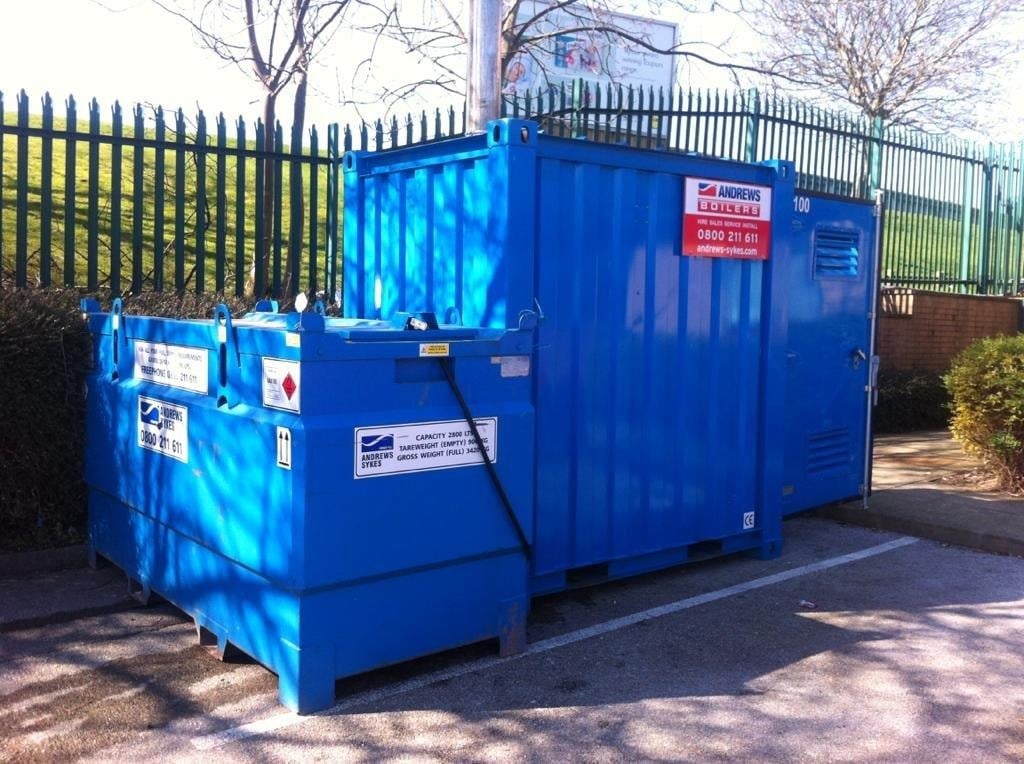
Temporary boiler hire is built for exactly this situation. Andrews Sykes hires out electric, gas and oil-fuelled units, from 22kW electric boilers up to large packaged boilers such as the 300kW unit. A hire unit can supply heating and hot water to any commercial or industrial building, whatever the sector, while the original boiler is repaired or replaced, and a heat exchanger can keep the hire boiler’s water separate from the building’s own circuit. For a single occupied area rather than a whole building, temporary heater hire can cover the gap. Trailer-mounted mobile boiler hire suits sites that need rapid deployment.
The approach has worked in practice. After a fire destroyed the biomass boiler at a specialist school in North Wales, a 300kW boiler with a 3,000 litre bunded fuel tank restored heating across the whole site by 1pm the next day, even though access to the boiler house was blocked (see the school boiler breakdown case study). In February 2026, a split district mains left a hospital ward in Bath without heating on a cold Thursday afternoon, and two 300kW boilers were installed and operational by the next morning (see the Bath hospital case study).
Need Heating Back On?
| If your boiler has failed, or you want a plan in place before it does, call us on 0800 211 611. Our 24/7 service covers emergency boiler hire, same-day delivery where possible and a free site survey to confirm the right unit and connection for your building. |
|---|
FAQs
What is the most common cause of boiler failure?
Poor maintenance is usually the biggest factor: missed servicing lets small faults, limescale and sludge develop unnoticed. Age is the other main cause. A traditional gas boiler is designed to last 10 to 15 years with appropriate maintenance, and sometimes up to 20. Regular servicing and water treatment are the most reliable ways to reduce the risk.
Can I hire a temporary boiler in an emergency?
Yes. Andrews Boilers offers emergency boiler hire 24/7, with same-day delivery where possible and a guaranteed 4-hour response from our UK depots. Our engineers deliver, install and commission the unit. A free site survey can confirm the right size, connection point and fuel or power supply for your building.
What happens if a boiler fails in a commercial building?
You lose heating and often hot water, which can stop showers, kitchens and laundry as well. Occupants become uncomfortable, pipework can freeze in cold weather, and work, teaching or patient care can be disrupted. A hotel can lose guest showers, a care home has residents who must be kept warm, and a leisure centre can face cold pools and changing rooms and closure. Employers are expected to provide a reasonable workplace temperature, and the approved guidance suggests at least 16°C for most indoor work, so a prolonged failure needs a plan. Temporary heating can bridge the gap while the boiler is repaired or replaced.


